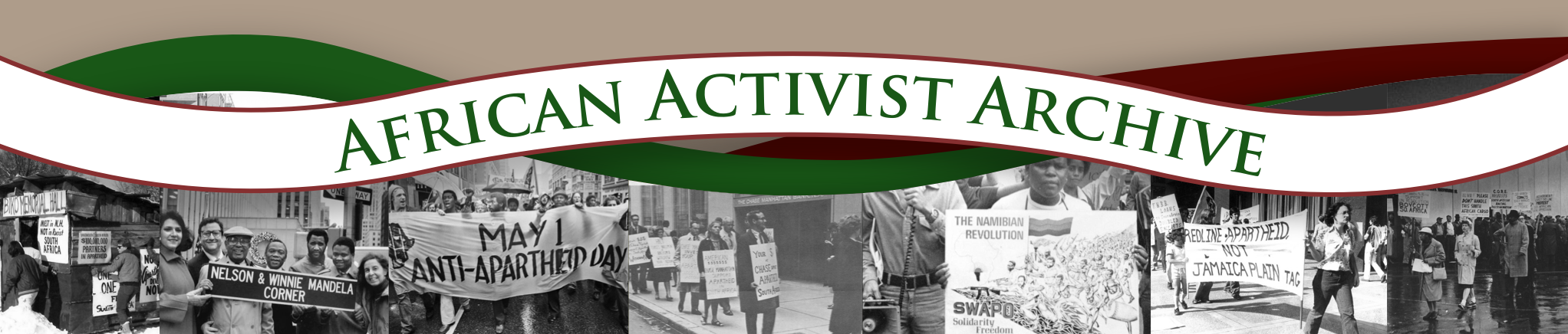
Background Gallery Image

African Activist Archive

Menu Hamburger Menu Icon
  • Home
  • Browse
  • Archives List
  • About down-arrow.svg
    • About AAAP Collection Policy MSU Project Partners Project Staff and Advisory Committee Acknowledgements Contact Contribute Content Donate
  • Related Sites
  • Advanced Search

About

  • African Activist Archive Project
  • Collection Policy
  • Michigan State University Project Partners
  • Project Staff and Advisory Committee
  • Acknowledgements
  • Contact
  • Contribute Content
  • Donate

African Activist Archive Project

The African Activist Archive Project is building an online archive of primary materials - documents, photographs, artifacts, and written and oral memories - of 50 years of activist organizing in the United States in solidarity with African struggles against colonialism, apartheid, and injustice. This is a "people's archive" focused primarily on local organizations in the U.S. that supported African struggles against colonialism and white minority rule. We also include materials from national organizations that provided research, educational and organizing materials, and some reporting about these local community and campus groups.

The U.S. African solidarity movement was racially...
The African Activist Archive Project is building an online archive of primary materials - documents, photographs, artifacts, and written and oral memories - of 50 years of activist organizing in the United States in solidarity with African struggles against colonialism, apartheid, and injustice. This is a "people's archive" focused primarily on local organizations in the U.S. that supported African struggles against colonialism and white minority rule. We also include materials from national organizations that provided research, educational and organizing materials, and some reporting about these local community and campus groups.

The U.S. African solidarity movement was racially diverse and was a significant part of the broad struggle against racism in the United States. The movement involved many types of organizations across the country, and this project seeks to document as many organizations as possible that participated in activist work in solidarity with African people's struggles. The geographic focus of activism in the collection is Angola, Guinea-Bissau, Mozambique, Namibia, South Africa, and Zimbabwe; however, this focus is not exclusive.

This movement offers important lessons about popular organizing for social justice. The anti-apartheid movement of the 1970s-1994, in particular, was unprecedented. Campaigns by community activists, students, faculty, churches, unions, and city, county, and state legislators led to divestment from U.S. companies doing business in South Africa and culminated in passage of the Comprehensive Anti-Apartheid Act of 1986 that changed U.S. foreign policy over President Reagan's veto.

Organizations in the African solidarity movement created newsletters, pamphlets, leaflets, policy and strategy papers, meeting minutes, correspondence, and graphic, audio and visual material such as posters, buttons, T-shirts, photos, slideshows, radio interviews, and videos. Many groups and coalitions no longer exist, but individuals associated with them have preserved many vital records.

We are eager to work with anyone who can help document additional campaigns and organizations to be included in this online archive. We also encourage people to submit written remembrances and audio or video interviews. Please contact the project if you would like to Contribute Content to this website or donate materials to a physical archive.
Show All Text

Collection Policy

The African Activist Archive Project's approach to preserving collections of materials and selecting material for posting on the website is based on the project's mission. Our purpose is to preserve and make freely accessible to the public multimedia materials that reveal the history of people in local groups across the United States that took action in solidarity with struggles against colonialism, apartheid, and social injustice in Africa during the second half of the 20th century.

Guidelines for choosing collections, selecting items from them, and digitizing objects for preservation and access reflect several unusual characteristics of this archival project.

Collections:...
The African Activist Archive Project's approach to preserving collections of materials and selecting material for posting on the website is based on the project's mission. Our purpose is to preserve and make freely accessible to the public multimedia materials that reveal the history of people in local groups across the United States that took action in solidarity with struggles against colonialism, apartheid, and social injustice in Africa during the second half of the 20th century.

Guidelines for choosing collections, selecting items from them, and digitizing objects for preservation and access reflect several unusual characteristics of this archival project.

Collections: The project began by encouraging activists to locate and save their personal collections of papers and multimedia materials. This is very different from most digitizing projects that begin with collections already organized, described, and stored at a single institution. The African Activist Archive still is encouraging people to create new collections, and we will help to arrange deposit of materials in an archive - either the Michigan State University Libraries' Special Collections or another library or historical society of their choice. Collections may consist of a wide variety of material including publications (leaflets, newsletters, pamphlets, articles, press releases, etc.), testimony, speeches, correspondence, buttons, T-shirts, posters, photos, and audio and video materials. We also will work with individuals who wish to keep their materials but who are willing to lend us items to digitize for the website or who wish to digitize selected items themselves.

Copyright status: Some organizing materials were created for public dissemination in order to publicize events or campaigns, so we regard these types of objects as being in the public domain: press releases, leaflets, public testimony, buttons, posters, and T-shirts. Some activist campaigns sought to change federal, state, or city laws; therefore, public documents are relevant to this archive. We treat bills, laws, resolutions, and hearings of all levels of government as being in the public domain.

We make reasonable efforts to seek permission to publish online written materials such as newsletters, authored publications, brochures and pamphlets, statements of purpose, and organizational minutes, as well as interviews, audio and video recordings, and photographs.

Many local organizations and coalitions involved in African solidarity work were run by volunteers and had no paid staff. Often they published print and graphic materials without attribution. Furthermore, most of these organizations no longer exist, which makes it very challenging to obtain permission to digitize and publish these materials online. To post materials of organizations that no longer exist, we attempt to locate leading members and request their permission. We seek permission from the current staff of organizations that still exist.

We believe that this policy regarding copyright status is sound and appropriate to the project; however, we are willing to remove objects from the online archive if individuals inform us inform us that they hold the copyright to certain materials and do not wish to have them on the site.

Guidelines for Selecting Materials for Digitizing:

Documents: From papers of a local organization, we typically select newsletters, statements of purpose, and diverse types of documents - such as leaflets, educational pamphlets, press releases, articles, event programs, and testimony - about one or more campaigns.

Multimedia objects: We give priority to photographs, posters, buttons, T-shirts, audio, and video, in order to enhance and enliven the written historical record. However, old audio and video items may be particularly costly to digitize.

Private collections: We are willing to consult with and post documents and other objects selected by individuals from their personal collections that meet these guidelines.

Within these selection guidelines, materials in the online archive may reflect limits of the collections we have accessed as well as project funding. In the case of some organizations, we have digitized everything meeting our guidelines from one or more archives that we have located. In other cases, we have obtained one or more partial collections and either are not aware of other archives or have not yet been able to access archives located far away. In yet other cases, we have access to large collections from an organization to which we may return to digitize further materials that meet our guidelines as additional funding becomes available.

We give priority to digitizing materials not included in other digitizing projects. Our main objective is to preserve and provide access to materials from local organizations whose records are likely to be lost unless we make a concerted effort. We also include materials from some national organizations because they often provided important resources for local campaigns as well as reports on the activities of local groups.

Although our focus is on the U.S. solidarity movement, we are willing to include in the online archive images, audio and video (but not documents at this time) provided to the project by organizations in other countries or otherwise available for digitizing at low cost.

This online African Activist Archive does not include documentation of the activities of African peoples in their own countries with whom international activists acted in solidarity. We are creating this archive to complement the many important archival projects underway in Africa to preserve this important history.

Digitizing, metadata creation, and preservation: Existing best practices are being used by Matrix and the African Studies Center at Michigan State University to create digital preservation and access copies of text, image, audio, and video objects for this project. We also will accept digital files appropriate for online access from organizations that wish to make materials available on this website but do not ask us to provide digital preservation. Metadata are based on Dublin Core standards. The open-source [Kora-link to Kora page (where?)] application created by Matrix is the digital repository used for the project.

Contributions of materials and funding: Please contact the project if you would like to contribute materials from an organization in which you participated. We will add as many materials as possible as described in this collection policy, subject to the constraints of our funding resources. The African Activist Archive is grateful to the foundations, organizations, and individuals (listed on the About page) that have provided financial support. We continue to seek funding for the project in order to add more organization's collections and expand the content from organizations already represented.
Show All Text

Michigan State University Project Partners

The African Activist Archive Project is cosponsored by the African Studies Center and Matrix: The Center for Digital Humanities and Social Sciences at Michigan State University, which have cooperated on projects about Africa for more than a decade.

Established in 1960, the African Studies Center at Michigan State University is a Title VI National Resource Center on Africa designated by the U.S. Department of Education, with 160 faculty across the university and offering graduate students the opportunity to learn 30 African...
The African Activist Archive Project is cosponsored by the African Studies Center and Matrix: The Center for Digital Humanities and Social Sciences at Michigan State University, which have cooperated on projects about Africa for more than a decade.

Established in 1960, the African Studies Center at Michigan State University is a Title VI National Resource Center on Africa designated by the U.S. Department of Education, with 160 faculty across the university and offering graduate students the opportunity to learn 30 African languages. Its outreach programs provide information about Africa to teachers and students, the media, scholars, policy-makers, and the public throughout the country. The Center has provided financial administration and digitizing assistance to the African Activist Archive Project.

Matrix is one of the premier humanities computing centers in the United States. It creates and maintains online resources, provides training in computing and new teaching technologies, and creates forums for the exchange of ideas and expertise in the field. Matrix provided website design and programming for the African Activist Archive and hosts its website.

Matrix houses major digital library repositories, including several about Africa cosponsored by Matrix and the African Studies Center. These include the curriculum resource South Africa: Overcoming Apartheid, Building Democracy and the Community Video Education Trust archive of video recordings of political resistance, state brutality, and press conferences by community activists in Cape Town during the 1980s and early 1990s; and the African Media Program, a resource for identifying educational and feature films and videos about Africa. Also, Matrix cooperated with Detroit Public Television's American Black Journal to create an online video archive of its 40 years of programs.

Michigan State University Libraries has played an important role in this project by accepting donations of activist's multimedia collections related to the Project in the MSU Libraries Special Collections. The MSU Library has one of the nation's largest collections about Africa as well as a strong Special Collection of American Radicalism.
Show All Text

Project Staff and Advisory Committee

Richard Knight, Consulting Project Director


Jamie Monson, Principal Investigator, African Studies Center


Christine Root, MSU Project Manager, African Activist Archive


Project Advisory Committee


Marsha Bonner


Prexy Nesbitt


Kathleen Sheldon


David Wiley


Biographies of Staff and Advisory Committee members


Richard Knight, Consulting Project Director


Richard Knight has been active for more than 30 years in the U.S. movement in solidarity with African struggles and has been working to build the African Activist Archive since its inception in 2003. From 1975-2001, Knight worked...

Richard Knight, Consulting Project Director


Jamie Monson, Principal Investigator, African Studies Center


Christine Root, MSU Project Manager, African Activist Archive


Project Advisory Committee


Marsha Bonner


Prexy Nesbitt


Kathleen Sheldon


David Wiley


Biographies of Staff and Advisory Committee members


Richard Knight, Consulting Project Director


Richard Knight has been active for more than 30 years in the U.S. movement in solidarity with African struggles and has been working to build the African Activist Archive since its inception in 2003. From 1975-2001, Knight worked at the American Committee on Africa (ACOA) and its 501(c)3 associate, The Africa Fund. ACOA provided important national leadership in supporting African struggles against colonialism and apartheid and the sanctions and divestment movements. Richard Knight served as a program associate for the state and municipal divestment program, maintaining a list of state and city divestment actions, and was primary assistant to the Projects Director, Dumisani Kumalo. Knight was in regular contact with numerous organizations and individuals in the solidarity movement and maintained a database of activists. As a senior researcher, he monitored companies doing business in South Africa and Namibia and authored three editions of the Unified List of United States Companies Doing Business in South Africa. From the mid-1980s-2002, Knight prepared ACOA and The Africa Fund materials for archiving at Amistad Research Center in New Orleans. His personal web site is www.richardknight.com.


Jamie Monson, Principal Investigator, Michigan State University


Jamie Monson is the director of the African Studies Center at Michigan State University, where she is also a professor of History. Dr. Monson received her MA in African Area Studies and her PhD in African History from the University of California, Los Angeles. Her current research focuses on Chinese development assistance to Africa. She is a specialist on the TAZARA railway, a development project built in Tanzania and Zambia with Chinese development cooperation in the 1970s. Her book, Africa's Freedom Railway: How a Chinese Development Project Changed Lives and Livelihoods in Tanzania (Indiana, 2009) has been widely acclaimed and has been recently published in Chinese (2015). Professor Monson's new research projects concern technology transfer and civil diplomacy in China-Africa engagement. She also has a strong background in African agricultural and environmental history, an interest she developed originally as a Peace Corps Volunteer in Kenya. She speaks Swahili, German and French and has been studying Chinese since 2009.


Christine Root, MSU Project Manager


Christine Root manages development of the digital repository and website of the AAAP. She also was a project manager of the multimedia online curriculum South Africa: Overcoming Apartheid, Building Democracy created by MATRIX and the African Studies Center. Root was active in the African solidarity and anti-apartheid movement beginning in the early 1970s. She served as Associate Director of the Washington Office on Africa from 1973-1981, and in 1983 she staffed the legislative campaign of the Center for International Policy to stop U.S. support for IMF loans to South Africa. She also was active in local organizing of the D.C. Bank Campaign and DC Divest. She served for several years in the 1980s as Political Action Committee co-chairperson of the Association of Concerned Africa Scholars. In 1986, she served on the Democratic Research Staff of the Michigan House of Representatives, working on the state public employee pension funds divestment legislation. Root worked at MSU for 15 years on grant development at the International Studies and Programs, MATRIX, and the History Department.


African Activist Archive Project Advisory Committee Members


Marsha Bonner is Director of Programs, Community Grantmaking and Special Initiatives at the Annenberg Foundation. Prior to this, she was Vice President for Programs at the Marin Community Foundation, a Trustee of the Edward W. Hazen Foundation and Associate Director of the Aaron Diamond Foundation, a private New York City foundation that funded in the areas of AIDS medical research, minority education, arts and culture, civil liberties, and human rights. Bonner formerly served as Trustee of The Africa Fund. She was a student anti-apartheid activist at Princeton University in the People's Front for the Liberation of Southern Africa and an intern at the American Committee on Africa.


Prexy Nesbitt is a long-time African activist in Chicago with extensive national and international experience. He formerly served on the staff of the American Committee on Africa and the board of The Africa Fund. He founded the Coalition for Illinois' Divestment from South Africa and the Chicago Committee for the Liberation of Angola, Mozambique and Guinea-Bissau (CCLAMG). He co-founded with Robert Van Lierop the Africa Information Service in New York, was the first national chair of the Committee to Oppose Bank Loans to South Africa and helped organize anti-apartheid campaigns in other key U.S. cities, including San Francisco, New York, Detroit, Nashville, Houston, and Seattle during the 1970s-80s. He ran the Mozambique Solidarity Office on behalf of the government of Mozambique. He worked in Tanzania for Frelimo's secondary school, the Mozambique Institute, in1968-1969. He also worked as a program officer for MacArthur Foundation and as program director of the Program to Combat Racism of the World Council of Churches. His writings include Apartheid in Our Living Rooms (1986). He currently conducts tours through Making the Road.


Kathleen Sheldon is an independent historian with a research affiliation at the University of California at Los Angeles (UCLA) Center for the Study of Women. She earned a certificate in African Studies as an undergraduate at Northwestern University and completed her M.A. in African Area Studies and her Ph.D. in history from UCLA. Sheldon was active in the Mozambique Support Network and was on the collective steering committee of its Los Angeles Chapter from 1987 to 1993. Her research focuses on Mozambican and African women’s history. Her most recent book is African Women: Early History to the 21st Century. Other publications include the second revised edition of the Historical Dictionary of Women in Sub-Saharan Africa (2016; first edition, 2005), a special two-part forum on Women and Gender in Africa for the African Studies Review, co-edited with Judith Van Allen, that appeared in December 2015 and April 2016, and Pounders of Grain: A History of Women, Work, and Politics in Mozambique (2002). She is on the editorial board for the online resource, Oxford Research Encyclopedia in African History. She serves as an editor for H-Luso-Africa, an H-Net network on Portuguese-speaking Africa, and she has served as Board member and Treasurer of the African Studies Association.


David Wiley David Wiley is a retired Professor of Sociology and African Studies at Michigan State University and was the Director of the MSU African Studies Center from 1977 to 2008. Under his leadership, the Center developed extensive links with African universities and worked with educational and cultural heritage institutions in Africa to preserve the history of African struggles. He served as President of the African Studies Association in 1998-99. At MSU, he was active in the Southern African Liberation Committee, whose activities led MSU to divest in from companies doing business in South Africa in 1978 and organized pressure on the state legislature to adopt three sanctions laws on South Africa. Before coming to MSU, he was one of the organizing founders in 1965 of the New Jersey Committee on Southern Africa; was one of the organizers of the Southern African Committee of the National Student Christian Federation; and helped form the Madison Area Committee on Southern Africa in 1969. He was a founding board member, and co-chairperson in 1991-93, of the Association of Concerned Africa Scholars, a national activist organization formed at MSU in 1977.


The African Activist Archive Project acknowledges and thanks these individuals who contributed to the Project by serving on the Advisory Committee in the past.


J.D. Moore Crossey (1932-2022) was Curator of the African Collection at Yale University's Sterling Memorial Library from 1963-1998. Under his direction the African Collection developed a particularly strong focus on Anglophone southern, central, east, and west Africa; Francophone and Lusophone countries are also strongly represented. He has extensive experience in the collection of ephemera both from Africa and U.S. He assisted Yale in acquiring collections from U.S. solidarity organizations. For many years Crossey was an active participant in the Cooperative Africana Microform Project run by the Center for Research Libraries in Chicago.


Jennifer Davis (1933 - 2019), born in South Africa, became an active opponent of apartheid while at the University of the Witwatersrand. She left South Africa in 1966 with her family, under threat of possible house arrest. In 1967, she began work at the American Committee on Africa and The Africa Fund, where she became Executive Director in 1981. Under her leadership, ACOA strengthened alliances to build national campaigns that led many churches, universities, states, and cities to divest from companies investing in apartheid South Africa and, ultimately, the Congress to adopt sanctions. She wrote extensively and testified frequently before Congress and the United Nations on issues ranging from U.S. military support for Portuguese colonialism to the negative impact of U.S. corporate investment in South Africa. She also served as editor of Southern Africa magazine. Davis maintained close connections with a broad range of people, some of whom were transformed from political prisoners or so-called terrorists to internationally recognized Nobel Laureates and political figures such as Nelson Mandela, Graca Machel and Desmond Tutu. After leaving ACOA in March 2000 she served on the board of Shared Interest.


George M. Houser (1916 – 2015) was a founder in 1953 of the American Committee on Africa (ACOA) and served as its Executive Director (1955-1981) and of The Africa Fund (1966-1981). Prior to his time at ACOA, he was an activist in the U.S. civil rights struggle, including as staff of the Fellowship of Reconciliation for 13 years. In 1942 He was a founder with James Farmer of the Congress of Racial Equality (CORE) and served as Executive Secretary for 10 years. In 1947 he, with Bayard Rustin, was an organizer and participant in the very first freedom ride, the Journey of Reconciliation. Houser built on these foundations in creating valuable links between the African and African-American freedom struggles. Houser's African solidarity work began in 1952 when he organized support in the U.S. for the ANC-led Defiance Campaign in South Africa. At ACOA he spearheaded numerous campaigns supporting African struggles for liberation and independence from Algeria to Zimbabwe. Beginning in 1954, he traveled to Africa more than 30 times, and his support of liberation movements led him to develop close ties with many African leaders including Amilcar Cabral, Julius Nyerere, Eduardo Mondlane, Kwame Nkrumah, and Oliver Tambo. He wrote numerous articles and two books, No One Can Stop the Rain: Glimpses of Africa's Liberation Struggle (New York: Pilgrim Press, 1989) and, with Herbert Shore, I Will Go Singing: Walter Sisulu Speaks of his Life and the Struggle for Freedom in South Africa (Cape Town: Robben Island Museum, 2000).


Dumisani S. Kumalo (1947 – 2019) was forced into exile from South Africa in 1977 for his anti-apartheid activities and sought asylum in the United States. He served as Project Director at the American Committee on Africa (ACOA) and its sister organization, The Africa Fund from 1979 to 1997. He played a key role in mobilizing support for U.S. sanctions against apartheid, helping to build the movement that led 28 states, 24 counties, more than 90 cities, and 155 colleges and universities to divest from U.S. banks and companies that did business with South Africa. He visited almost every state in the union, testifying before state legislatures and city councils and speaking in communities and at countless colleges and universities. Before going into exile from South Africa, Kumalo worked as a political reporter for the Golden City Post, World Newspapers, DRUM, and the Johannesburg Sunday Times. After the end of apartheid, he returned to South Africa and, in 1997, was appointed Director of the United States Desk in the Department of Foreign Affairs. Kumalo served as South Africa's Ambassador to the United Nations from 1999 to 2009 and then as the Chief Director of the South African Department of Foreign Affairs and as the Special Representative to the Great Lakes. He was the first Chief Executive Officer of the Thabo Mbeki Foundation, serving in that capacity from 2011 to 2015.


Canon Frederick B. Williams (1939 – 2006) served as Rector at the Church of the Intercession in New York City beginning in 1972 where he hosted African liberation leaders such as Archbishop Desmond Tutu. He was a Trustee of General Theological Seminary and on the Advisory Council of the New York Landmarks Conservancy. Beginning in 1966, Williams visited Africa many times. In the early 1970s he introduced Lea Tutu, then working with domestic workers in South Africa, to Marie Lewis, President of the Household Technicians Inc. He is a former board member of Africa Action and its predecessor the American Committee on Africa and was a founding member of the Religious Action Network for Peace and Justice in South Africa. He is also a founder of the International Conference on Afro-Anglicanism which brings together Anglicans of the African Diaspora once a decade. He was named an honorary canon of the cathedral in Gaborone, Botswana for his work in support of the liberation movements. He gave the opening address XIII International Conference on AIDS in Durban, South Africa in 2000.

Show All Text

Acknowledgements

We thank the many people who have provided documents, photographs, audio and video materials, physical artifacts, written remembrances, and interviews for inclusion in this online archive. These individuals are identified on the webpages of these objects.

We gratefully acknowledge the generous financial support to the African Activist Archive Project from numerous individual contributors and the following:

Community Church of New York, Unitarian Universalist
Communication Workers of America Local 1180
DJB Foundation
Evangelical Lutheran Church in America
Ford Foundation
Hartford Memorial Baptist Church
Marin Community Foundation
Normandie...
We thank the many people who have provided documents, photographs, audio and video materials, physical artifacts, written remembrances, and interviews for inclusion in this online archive. These individuals are identified on the webpages of these objects.

We gratefully acknowledge the generous financial support to the African Activist Archive Project from numerous individual contributors and the following:

Community Church of New York, Unitarian Universalist
Communication Workers of America Local 1180
DJB Foundation
Evangelical Lutheran Church in America
Ford Foundation
Hartford Memorial Baptist Church
Marin Community Foundation
Normandie Foundation
Our Developing World
Samuel Rubin Foundation
Social Service Employees Union Local 371
African Studies Center, Michigan State University
Numerous individual contributors

We continue to seek funding for general support or digitizing particular collections or categories of materials in order to expand both the depth and breadth of this online archive. Please make inquiries to about donating materials or financial support to Consulting Project Director [Richard Knight-mail link to: rvknight@earthlink.net].
Show All Text

Contact

Richard Knight
Consulting Project Director, African Activist Archive
521 West 122nd St., Suite 61
New York, NY 10027
rvknight@earthlink.net
Telephone: (646) 684-1405

Christine Root
MSU Project Manager, African Activist Archive
rootc@msu.edu
Telephone: (517) 332-0333

Facebook Michigan State University African Online Digital Library Matrix: Center for Digital Humanities & Social Sciences
Alternate Text Populated by JS